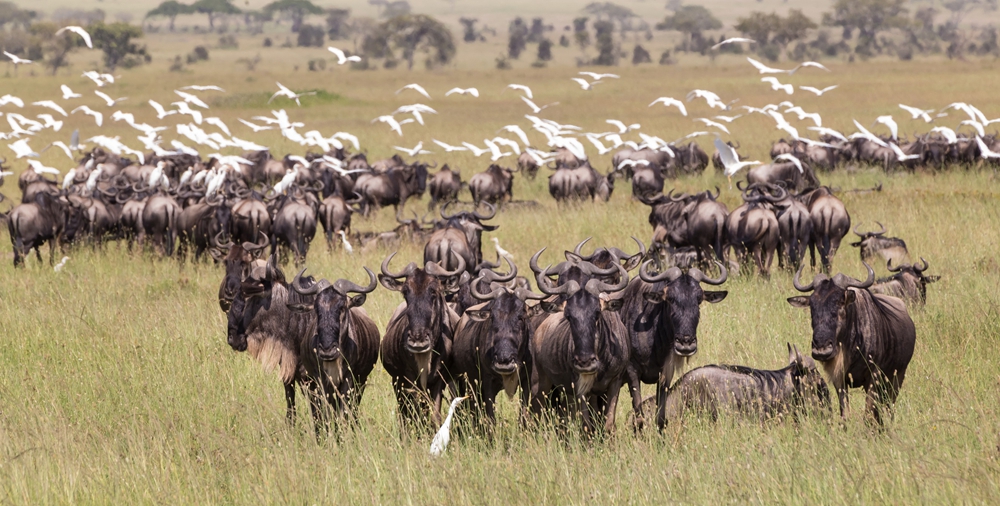
There is good reason why Jane Serraungedi has become the filming location for so many wildlife documentaries. Visitors are almost certain to see a wide variety of amazing wildlife.
Serengeti is home to an astonishing number of animals, including 8,500 giraffes, 10,000 antelopes, 200,000 zebras, 1.3 million wildebeests, 1,500 lions, 1,000 elephants, 280,000 Thomsons gazelles, 25,000 water buffalo, 500 species of birds, 72,000 kudus and 32,000 Gerstens.
The annual wildebeest migration stands as one of the worlds most spectacular and awe-inspiring natural spectacles. From Kenyas Serengeti to the Maasai Mara, over 1.4 million wildebeests, along with 200,000 zebras and antelopes, embark on an annual 1,800-mile clockwise journey to seek rain-fed grasslands. This massive migration proves so extensive that even during the peak migration season from August to November when wildebeest are expected to gather in Kenyas Maasai Mara, Serengeti remains teeming with wildlife. The "local residents" choose to stay put rather than join the main herds march.
Note that the Serengeti is still rich in wildlife even between August and November (roughly the period most wildebeests are expected to spend in the Maasai Mara), as "resident" animals choose to stay where they are rather than follow migratory herds.
Location: Located on the Northern Ring Road, outside Arusha city, 7 hours away from Arusha and 2.5 hours away from the crater of Mount Engoro Engoro. Activities: Drive to see wildlife, take a hot air balloon ride, walk through the jungle and drive at night to see wildlife.
How long to stay: The average length of stay is 3 to 4 nights, and its recommended to stay at least 2 nights.
Animals: With the exception of rhinos, you can see almost all the animals commonly seen during the hunt.